
The design guide to office acoustics
Everything you need to know when designing for better office acoustics

Sound strategies for managing workplace noise
Discover how to reduce noise, improve focus, and create a more productive office with our design guide to office acoustics.

THE IMPORTANCE OF OFFICE ACOUSTICS
Today’s offices are louder by design. To create environments that truly support productivity, well-being, and focus, acoustic strategies must evolve.
Inside the guide
- The impacts of office noise
- How sound works at the office
- The importance of private workspaces
- Modern solutions for workplace acoustics
- Tips for creating an effective acoustic strategy


Over 70% of employees in open plan offices report dissatisfaction with workplace noise.

The cost of a noisy office
Noise disrupts focus, raises stress, and lowers productivity. Learn how better office acoustics can help your teams work, feel, and perform better.
BETTER ACOUSTICS SUPPORT BETTER WORK
Optimize your office acoustics
Creating a balanced office requires a layered approach to managing noise. By combining materials, technology, and design, you can minimize distractions, enhance privacy, and promote focus throughout the office.
Traditional treatments
Absorptive and diffusive materials that manage sound at the
surface level.
Layout optimization
Office design that minimizes noise transfer and supports task-based zones.
Private workspaces
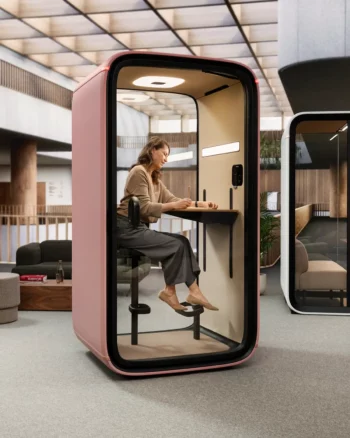
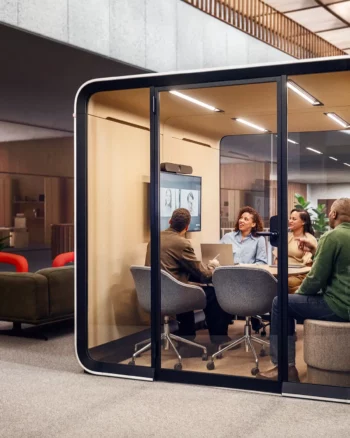
Enclosed spaces that support focus, speech privacy, and recovery.

Offices that use acoustic zoning and layout strategies report a 25–30% reduction in noise complaints and higher satisfaction with speech privacy.
Gensler Research Institute¹ (2019)
Frequently asked questions about office acoustics
How can I improve the acoustics in my office?
To improve office acoustics, use a three-part strategy:
∙ Install acoustic treatments such as sound-absorbing panels and soft furniture to reduce echo and reverberation.
∙ Implement sound masking systems or acoustic sensors to monitor and manage background noise.
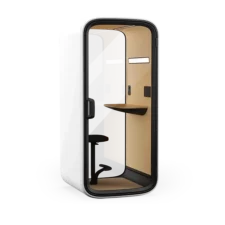
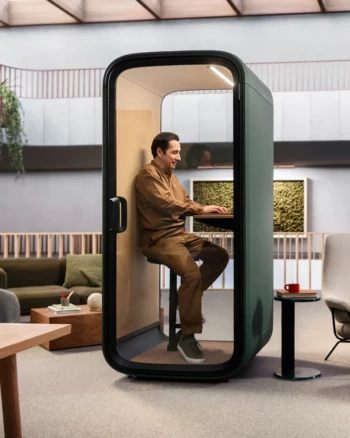
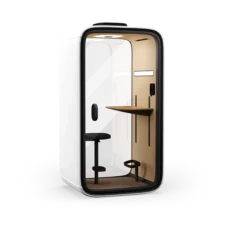
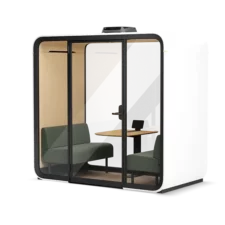
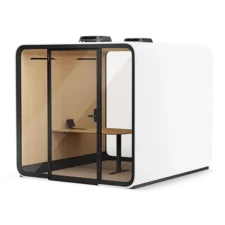
∙ Design for noise control using zoning, layout changes, and sound-isolating solutions like Framery soundproof pods.
This layered approach helps reduce distractions, improve speech clarity, and support focused work.
What causes poor acoustics in an office?
Poor office acoustics are typically caused by a combination of space design, materials, and noise sources:
∙ Hard surfaces like glass and concrete reflect sound, increasing echo and reverberation.
∙ Open layouts without zoning allow sound to travel freely, making it harder to focus.
∙ HVAC systems, office equipment, and conversations generate constant background noise.
Framery pods can be introduced to contain noise and create quieter, more focused workspaces in otherwise open environments.
What materials help absorb sound in office spaces?
Effective sound-absorbing materials help reduce reverberation and soften the overall acoustic environment:
∙ Acoustic wall panels and ceiling baffles absorb mid-to-high frequency sounds like speech.
∙ Carpets, curtains, and upholstered furniture help control footfall and impact noise.
∙ Fabric-covered surfaces and soft partitions improve acoustic comfort in shared spaces.
Framery smart pods combine all of these elements with a Class A soundproof structure to minimize sound leakage and enhance interior speech clarity.
What should I consider when designing for office acoustics and noise control?
Designing for acoustics means managing how sound moves through a space:
∙ Use zoning strategies to separate quiet focus areas from collaborative or social zones.
∙ Choose materials that absorb and diffuse sound, especially in high-use areas.
∙ Include enclosed spaces like Framery soundproof pods to support privacy, deep focus, and hybrid meetings.
Smart acoustic design ensures different workstyles can coexist without compromising comfort or performance.
What are the acoustic requirements for offices?
ISO 22955 and ISO 3382-3 guidelines for office acoustics recommend:
∙ Ambient noise levels between 35–45 dB(A)
∙ Reverberation time (RT60) of 0.6–0.8 seconds
∙ Distraction distance (rD) under 4.5 meters in open-plan spaces
Meeting these standards supports focus, comfort, and collaboration—and can be achieved by combining material choices, spatial planning, and sound-isolating solutions like Framery pods.
What is the ISO standard for office pod acoustics?
ISO 23351-1:2020 defines the acoustic performance criteria for office pods and similar enclosed furniture. The standard measures:
∙ Speech level reduction (DS,A) — how much conversational speech is blocked from escaping the pod
∙ Class A rating — achieved when DS,A is 30 dB or higher, suitable for confidential conversations and hybrid meetings
∙ Consistent test methodology — to ensure reliable, comparable performance across pod types and brands
Framery pods are Class A–rated and engineered to exceed these standards through advanced soundproofing and precision-tuned acoustic interiors.